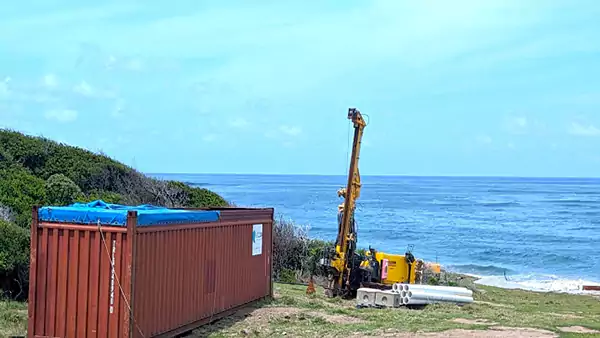
Drilling Equipment For Nevis Desalination Plant
Construction of the photovoltaic desalination plant in Butlers, St. James, continues to progress as the Nevis Island Administration (NIA) works to improve the island’s water supply. Designed to support both residents and businesses, the project represents a major step toward ensuring long-term water security for Nevis.
Government Leaders Evaluate Progress
On April 18, 2024, the Honourable Spencer Brand, Minister with responsibility for Water Services, visited the construction site alongside Operations Manager Roger Hanley of the Nevis Water Department and Energy Commissioner Renee Walters of the Premier’s Ministry. The visit highlighted the administration’s commitment to expanding access to clean water through sustainable technology.
Minister Brand explained that the desalination plant forms part of a Federal pilot project funded by the United Arab Emirates (UAE) Caribbean Renewable Energy Fund (CREF). He emphasized that its impact would extend beyond the St. James community, benefiting the wider island as water challenges continue to grow.
The Importance of a New Water Source
Nevis has experienced increasing pressure on its deep well supply, making the development of alternative water sources essential. Minister Brand expressed optimism that the plant could begin contributing water to the island’s network within a few months.
He explained that the facility’s solar-powered design was chosen to reduce operational costs. If successful, the pilot project will help determine whether larger desalination facilities could be introduced in the future, especially as the island works toward developing geothermal energy.
Potential for Future Expansion
The minister noted that while desalination is effective, it is traditionally expensive due to high energy demands. By pairing desalination with renewable energy, Nevis aims to make long-term water production more affordable.
- Solar power will reduce energy consumption and operational costs.
- The project will act as a test case for future expansion.
- Geothermal development may further lower costs in coming years.
- Larger plants could eventually augment the island’s groundwater supply.
How the Desalination Process Works
Operations Manager Roger Hanley outlined the steps involved in converting ocean water into clean, drinkable water that meets World Health Organisation (WHO) standards. The system will rely on a coastal well to access brackish water, which will then undergo multiple stages of purification.
- Water is drawn from a coastal well near the shoreline.
- The water is pumped into a reverse osmosis unit.
- Membrane filtration removes salt and impurities.
- Demineralization ensures the water becomes palatable.
- The purified water is injected directly into the island’s distribution network.
The plant is designed to produce up to 70,000 gallons of water per day when operating with nighttime energy use. Under solar energy alone, it can generate approximately 30,000 gallons per day.
Meeting the Island’s Water Demands
Premier Mark Brantley thanked Minister Brand and the technical team overseeing the project, recognizing their dedication to improving the island’s water infrastructure. However, he stressed that while this desalination facility is an important advancement, it cannot fully resolve Nevis’ water shortages. The island consumes an average of 1.6 million gallons of water per day, far exceeding the plant’s output.
During his April 23 press conference, the Premier explained that large-scale desalination remains a future goal, but only after energy costs are reduced. Expanding geothermal energy capacity remains a priority, as it would make extensive desalination more financially viable.
Project Implementation Partners
Two key companies will support the construction and development of the plant:
- EXOFOR will conduct the drilling necessary to access coastal water.
- Kelly Construction will build the physical structure of the desalination facility.
As the project moves forward, the desalination plant stands as a crucial element in Nevis’ long-term strategy to provide reliable, sustainable water for its residents. By embracing renewable energy and modern water technology, the island is positioning itself for a more resilient future.